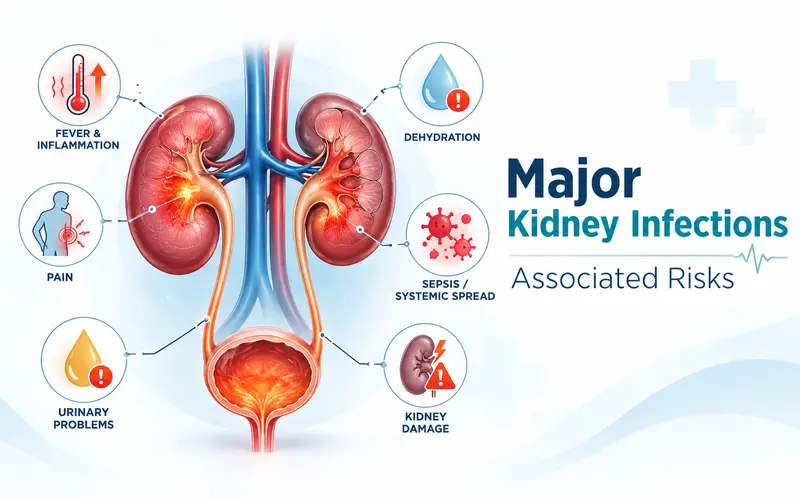
Major Kidney Infections and Their Associated Risks
A kidney infection (pyelonephritis) happens when bacteria travel from the bladder up into one or both kidneys. Roughly 1 in 30 untreated bladder infections progresses this way. Core symptoms are fever with chills, back or side pain, and painful or cloudy urination. Most cases need antibiotics for 10–14 days; severe cases, or those with vomiting, confusion, or very low urine output, need same-day hospital care, since an untreated kidney infection can progress to permanent kidney damage or sepsis.
A kidney infection isn't just a "bad UTI." It's a genuine infection of the kidney tissue itself, and while most cases resolve fully with prompt treatment, delayed or repeated infections carry real risks that are worth understanding clearly rather than dismissing as routine.
How a Kidney Infection Actually Develops
Most kidney infections start as a straightforward bladder infection (cystitis). Bacteria, usually E. coli from the gut, enter through the urethra and, left untreated, travel upward through the ureters into the kidneys. Roughly 1 in every 30 cystitis cases progresses to a kidney infection. Less commonly, bacteria reach the kidney through the bloodstream from an infection elsewhere in the body.
Kidney Infection Symptoms
| Symptom | What It Typically Feels Like |
|---|---|
| Fever and chills | Often high-grade, sometimes with shivering |
| Back, side, or groin pain | Constant ache, usually one-sided, below the ribs |
| Painful or burning urination | Similar to a UTI but often more intense |
| Urgent, frequent urination | Needing to go often, sometimes with little output |
| Cloudy, bloody, or foul-smelling urine | A clear sign infection has set in |
| Nausea and vomiting | More common than in a simple bladder infection |
| Confusion (in elderly patients) | Can appear instead of typical symptoms |
In young children, fever alone may be the only obvious sign, and in older adults, confusion or general weakness can appear before or instead of the classic symptoms above. This is one reason kidney infections are sometimes missed or diagnosed late in these groups.
It is also worth knowing that kidney infections and early signs of kidney deterioration can look similar on the surface. If symptoms persist or recur, getting kidney function properly evaluated makes sense rather than assuming it's just another infection.
Kidney Infection vs. Kidney Disease: Not the Same Thing
These two terms are frequently confused, but they describe very different conditions.
| Kidney Infection (Pyelonephritis) | Kidney Disease (CKD) | |
|---|---|---|
| Cause | Bacterial infection | Long-term damage from diabetes, high blood pressure, or other chronic conditions |
| Onset | Sudden, often within days | Gradual, over months or years |
| Duration | Typically resolves with antibiotics in 1–2 weeks | Long-term, often progressive |
| Reversibility | Usually fully reversible if treated promptly | Often not reversible; managed rather than cured |
| Relationship | Repeated or severe untreated infections can contribute to kidney disease over time | An underlying condition, not caused by a single infection |
Who Is Most at Risk
-
Women, due to a shorter urethra that allows bacteria to reach the bladder more easily
-
People with kidney stones or another urinary blockage
-
Anyone with diabetes or a weakened immune system
-
Pregnant women
-
People with vesicoureteral reflux (urine flowing backward toward the kidneys)
-
Those with a urinary catheter or recent urinary procedure
-
Men with an enlarged prostate restricting normal bladder emptying
The Real Risks of a Kidney Infection Left Untreated
A kidney infection treated promptly with antibiotics usually resolves completely without lasting damage. Left untreated, or treated too late, the risks escalate significantly. According to the National Health Portal of India, urinary tract infections that ascend to the kidneys are a recognised cause of preventable kidney damage, particularly in people with diabetes or structural abnormalities.
-
Permanent kidney scarring or damage, particularly with repeated infections
-
Sepsis, a life-threatening, body-wide response to infection that can be fatal without emergency treatment
-
Renal papillary necrosis, where infection damages the kidney's internal structures
-
Emphysematous pyelonephritis, a severe, gas-forming infection seen more often in people with diabetes
-
Chronic kidney disease, developing over time from repeated or poorly managed infections
-
Abscess formation within or around the kidney, sometimes requiring drainage
Kidney Infection: When to Go to Hospital
| Situation | What to Do |
|---|---|
| Fever, back pain, painful urination, otherwise stable | See a doctor promptly; oral antibiotics are often sufficient |
| Persistent vomiting, unable to keep fluids or medication down | Go to hospital; IV antibiotics and fluids likely needed |
| Little or no urine output | Go to hospital immediately |
| Confusion, severe weakness, or fainting | Go to hospital immediately, this may signal sepsis |
| Pregnant, diabetic, or immunocompromised with symptoms | Seek same-day medical evaluation regardless of severity |
| Symptoms not improving after 48–72 hours of antibiotics | Return for reassessment; the infection or bacteria may need a different approach |
Treatment of Kidney Infection
Treatment depends on severity, but generally includes:
-
Oral antibiotics for 10–14 days for uncomplicated cases, with follow-up to confirm the infection has cleared
-
Hospitalisation and IV antibiotics for severe infection, vomiting preventing oral medication, pregnancy complications, or when sepsis is suspected
-
Imaging (ultrasound or CT scan) to check for an underlying blockage, kidney stone, or abscess, especially if symptoms don't improve as expected
-
Addressing the underlying cause, such as removing a kidney stone or correcting reflux, to prevent recurrence
-
Pain relief and hydration alongside antibiotic treatment
Reducing Your Risk of Recurrence
-
Treat bladder infections early rather than waiting them out
-
Stay well hydrated to help flush bacteria from the urinary tract
-
Urinate after intercourse and avoid holding urine for long periods
-
Get kidney stones or urinary blockages properly evaluated and managed
-
Keep diabetes and blood pressure well controlled, since both raise infection and complication risk
Kidney Doctor in Haryana: When to Seek Specialist Care
A first, uncomplicated kidney infection can often be managed by a general physician. However, specialist nephrology or urology input becomes important if infections recur, if there's an underlying stone or structural issue, if kidney function shows any decline on blood tests, or if you have diabetes or another condition that raises your risk of complications.
A kidney infection is a genuine medical condition, not simply a worse version of a UTI, and while most cases resolve fully with prompt antibiotics, delayed treatment carries real risks including permanent kidney damage and sepsis. Knowing the difference between a straightforward infection and a kidney disease process, recognising when symptoms call for hospital care rather than a routine appointment, and addressing recurring infections with a specialist all meaningfully reduce those risks.
SS Kidney and Urology Hospital in Haryana offers experienced nephrology and urology care to manage kidney infections safely, from first presentation through to preventing recurrence. As a nephrology hospital equipped for both routine and complicated presentations, the team provides timely evaluation and treatment so a kidney infection is caught and managed before it progresses to a more serious complication. Book an appointment today.








Request A Callback