Is Polycystic kidney disease treatment and full cure possible in Haryana?
Chronic Kidney Disease affects nearly 17% of the Indian population, and Polycystic Kidney Disease (PKD) forms a significant genetic cause within this burden as per data published by ICMR. Many patients in Haryana discover PKD only after symptoms such as high blood pressure, abdominal discomfort, or reduced kidney function begin affecting daily life. The first question that follows diagnosis is direct: Can polycystic kidney disease be completely cured? PKD is a genetic condition with no permanent cure, but its progression can be controlled for years with structured treatment. The approach depends on disease stage, kidney function, and complications. Patients may move from monitoring and medication to dialysis or kidney transplant if the disease advances. In Haryana, access to nephrology care, dialysis, and transplant guidance allows patients to manage PKD effectively when diagnosed early and treated with a stage-based plan.
Is Polycystic Kidney Disease Curable in Haryana Patients
Polycystic kidney disease has no permanent cure because it is caused by genetic mutations that cannot be reversed. PKD develops due to inherited gene defects that lead to cyst formation inside the kidneys. These cysts continue to grow over time, gradually reducing kidney function. Since the root cause lies in genetic coding, current medical science does not offer a treatment that completely eliminates the disease. However, absence of a cure does not mean absence of treatment. Management focuses on slowing disease progression and controlling complications for as long as possible.
Patients in Haryana are typically managed through three structured levels:
-
Early stage (normal kidney function): Blood pressure control, lifestyle regulation, and regular monitoring
-
Moderate stage (declining function): Medication to slow cyst growth and manage symptoms
-
Advanced stage (kidney failure): Dialysis or kidney transplant in Haryana becomes necessary
Around 50% of patients with ADPKD reach kidney failure by the age of 60, which makes long-term planning essential. Kidney transplant is currently the closest option to a long-term solution. It replaces failed kidney function but does not remove the genetic condition from the body. In Haryana, access to nephrology hospitals, dialysis centers, and transplant guidance allows patients to live for years with controlled disease progression when treatment begins early.
Polycystic Kidney Disease Definition and Causes
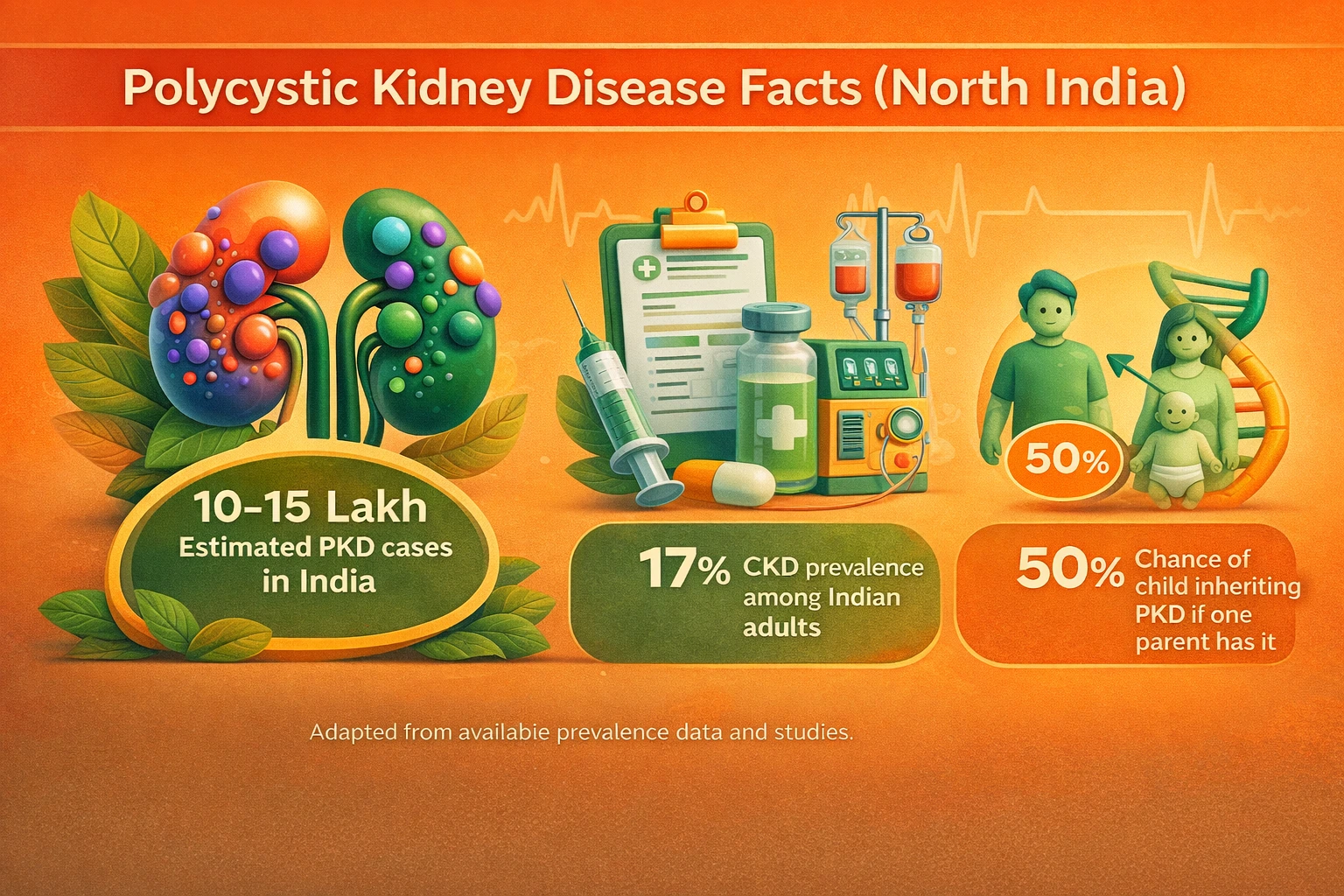
Each child of a parent with Polycystic Kidney Disease has a 50% chance of inheriting the condition, making it one of the most common genetic kidney disorders as per Mayo Clinic Polycystic Kidney Disease (PKD) is a condition where multiple fluid-filled cysts develop inside the kidneys, gradually increasing kidney size and reducing function over time.
There are two main types:
-
Autosomal Dominant PKD (ADPKD): Most common form. Symptoms usually appear between ages 30–50. Inherited from one affected parent.
-
Autosomal Recessive PKD (ARPKD): Rare and severe. Often diagnosed in infancy or early childhood.
In India, ADPKD forms the majority of diagnosed cases due to its delayed onset and genetic transmission pattern. Kidney size in PKD patients can increase up to 3–4 times normal, which directly impacts filtration ability and leads to progressive kidney damage. (PKD Foundation)
What Causes Polycystic Kidney Disease
PKD is caused by mutations in specific genes responsible for kidney cell structure and function. These mutations lead to abnormal cell growth and cyst formation.
-
Genetic inheritance (primary cause)
-
Family history of kidney disease
-
Mutation in PKD1 or PKD2 genes
There are no lifestyle or environmental causes that initiate PKD, but lifestyle factors can influence how fast the disease progresses.
Stages of Polycystic Kidney Disease and Treatment Haryana
Around 50% of patients with ADPKD progress to kidney failure by the age of 60, making stage-based management essential. (NHS) Polycystic Kidney Disease progresses slowly over years. Treatment decisions depend on kidney function level (GFR), cyst growth, and symptoms, not just diagnosis.
Stage 1–2 (Early Stage – Normal Kidney Function)
Kidney function remains above 60% in early stages, and symptoms may be minimal.
-
Blood pressure control
-
Regular ultrasound or CT scans
-
Lifestyle monitoring (salt, hydration, alcohol restriction)
-
Periodic kidney function tests
At this stage, treatment aims to delay cyst growth and preserve function.
Stage 3–4 (Moderate Stage – Declining Function)
Kidney function drops between 30% to 59%, and symptoms begin to appear more clearly.
Common changes:
-
Increased blood pressure
-
Fatigue and weakness
-
Frequent abdominal discomfort
Treatment approach:
-
Medication to control complications
-
Monitoring cyst growth rate
-
Managing electrolyte imbalance
-
Preparing for future dialysis planning
This stage is critical because progression speed varies significantly between patients.
Stage 5 (Advanced Stage – Kidney Failure)
Dialysis becomes necessary when kidney function falls below 15%, which defines end-stage kidney disease. (NHS) At this stage, waste removal function fails, fluid balance becomes unstable, and symptoms become severe.
Treatment options:
-
Dialysis (short-term or long-term support)
-
Kidney transplant (long-term solution)
Medication vs Dialysis vs Kidney Transplant Comparison
Dialysis is typically required when kidney function drops below 15%, while transplant offers 10–20+ years of survival in many patients.
| Treatment Type | When Required | Duration | Role in PKD | Outcome Trend |
|---|---|---|---|---|
| Medication & Monitoring | Early to mid stages (GFR >30%) | Long-term | Controls BP, slows progression | Delays kidney failure |
| Dialysis in Haryana | Advanced stage (GFR <15%) | Lifelong or until transplant | Replaces kidney function artificially | Sustains life but not permanent |
| Kidney Transplant | End-stage kidney failure | Long-term (10–20+ years) | Replaces failed kidney | Closest to long-term solution |
Frequently Asked Questions About PKD Treatment in Haryana
-
Can I live a normal life after PKD diagnosis?
Yes, many patients with Stage 1–3 PKD live active, normal lives for decades with proper monitoring and blood pressure control. Early diagnosis in Haryana allows structured management that delays serious complications significantly. -
Will my children also get PKD?
Each child of an ADPKD patient has a 50% chance of inheriting the condition. Genetic counselling and early kidney screening for children of affected parents is recommended. SS Kidney Hospital provides family-based evaluation guidance for PKD cases in Haryana. -
How often should I get my kidneys tested if I have PKD?
For Stage 1–2, kidney function tests and ultrasounds every 6–12 months are typically recommended. For Stage 3 and above, more frequent monitoring — sometimes every 3 months — is required. Your nephrologist will set the schedule based on your eGFR and cyst growth rate. -
Is dialysis the only option at end stage?
No. Dialysis is one option, but kidney transplant is available for eligible patients and offers a longer-term solution. At SS Kidney & Urology Hospital in Haryana, both dialysis support and transplant evaluation are available under one nephrology team. -
What foods should PKD patients avoid in Haryana?
High-sodium foods, excessive protein, caffeine, and alcohol can accelerate cyst growth and worsen blood pressure. A nephrologist-supervised diet plan specific to your stage and creatinine levels is more effective than general dietary advice. -
Where can I get PKD treatment in Haryana?
SS Kidney & Urology Hospital provides complete nephrology evaluation, stage-based PKD management, dialysis, and transplant guidance. The hospital serves patients across Haryana with structured kidney care under experienced nephrologists.
How Nephrology treatment in Haryana helps for PKD Patients
Many PKD patients in Haryana approach a nephrologist only after symptoms become severe — by which point kidney function has already declined significantly. The problem with PKD is that it is silent in early stages. Blood pressure rises, cysts grow, and eGFR drops — all without obvious warning signs.
Patients who begin structured nephrology care at Stage 1 or 2 have a significantly higher chance of delaying dialysis by 10–15 years compared to those who seek care at Stage 4 or 5. Early consultation is not about alarm — it is about preserving options.
If you or a family member in Haryana has been diagnosed with PKD, or if there is a family history of kidney cysts, an early nephrology evaluation at SS Kidney & Urology Hospital can establish a baseline, define your stage, and create a long-term management plan before complications develop.
Polycystic Kidney Disease cannot be completely cured, but it can be managed for years with structured treatment based on disease stage. PKD is a lifelong condition driven by genetic factors, which means treatment focuses on slowing progression, controlling symptoms, and preserving kidney function. Early stages rely on monitoring and medication, while advanced stages may require dialysis or kidney transplant. Up to 50% of patients may reach kidney failure by the age of 60, which makes early diagnosis and long-term planning essential. In Haryana, access to nephrology hospitals, dialysis facilities, and transplant guidance allows patients to follow a clear treatment pathway instead of waiting for complications to develop. Patients experiencing symptoms such as persistent abdominal discomfort, high blood pressure, or reduced kidney function should seek timely medical evaluation. Early intervention increases the chances of delaying dialysis and maintaining kidney health for a longer duration. SS Kidney & Urology Hospital in Haryana provides complete evaluation, dialysis support, and long-term kidney care planning, helping patients manage Polycystic Kidney Disease with a structured and stage-based approach.






Request A Callback